







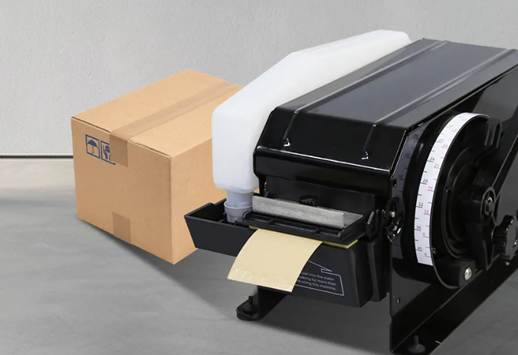
Packaging teams that switch from plastic tape to kraft paper tape usually expect the change to be about materials. It is not. The switch is really about a chemical reaction, and the equipment that triggers it — the water activated tape dispenser — is what determines whether that reaction happens properly on every carton or only on some of them.
Starch-based adhesive on gummed kraft tape stays inert until it meets water. Once moistened, it turns tacky, penetrates the paper surface of the corrugated board, and forms a fiber-to-fiber bond as it dries. Miss a patch of adhesive and that patch never bonds. Over-wet the tape and the adhesive dilutes, weakening the joint. This narrow window is why dispenser selection deserves more attention than it usually receives.
The Moistening Mechanism Is the Core Specification
Every dispenser in Air Power Pak’s range wets tape, but the mechanics differ, and so does the operator discipline required.
The GHC-50 handheld unit carries an 80 ml reservoir and a moistening brush positioned along the tape path. It is light — roughly 330 g — and needs no power connection. The unit suits 50 mm tape width with roll diameters up to 140 mm, and is designed for standard non-reinforced kraft tape. Its advantage is that a packer can carry it to wherever cartons are being sealed. Its constraint is that moisture transfer depends on how steadily the operator pulls. A smooth, even draw gives the brush time to wet the adhesive uniformly. A quick, jerky pull leaves dry streaks that lift within hours.
The NT-800 bench unit supports tape widths from 20 to 100 mm, custom lengths up to 1000 mm, and roll diameters up to 200 mm. One water fill handles roughly 100 to 200 standard cartons. The lever action feeds, moistens, and cuts in a single motion, which removes much of the variability that handheld use introduces.
The NT-AT 3.0 automatic model dispenses at 60 m/min with a 3.5 L tank and runs below 75 dB at shutoff. The larger reservoir matters less for its capacity than for the fact that it reduces mid-shift refill interruptions, which is where moisture consistency tends to drift. The sensor-operated Tape-AT dispenses at an average 60 m/min with a 2.5 L tank and adjustable water temperature from 0 to 80°C, a range that helps the adhesive activate faster in cooler rooms.
Warm Water Is Not a Gimmick
Buyers sometimes question whether adjustable water temperature is worth paying for. In an unheated warehouse in winter, it often is. Starch adhesive activates more readily in warm water, and the difference shows up in how quickly the tape grabs the carton surface. In a climate-controlled packing room the benefit is smaller; in a cold-loading dock it can be the difference between a seal that sets and one that slides before it dries.
Testing a New Unit Before Committing
The single most useful thing a buyer can do with a new dispenser is seal a dozen cartons and inspect them after the adhesive has fully dried — typically a few hours, or overnight for a proper check. Look for three things: even darkening across the tape width, no dry pale patches along either edge, and corners that stay down when the flap is flexed. A unit that wets one side more heavily than the other will fail the third test regardless of tank size or motor specification.
This test also reveals whether the blade is cutting cleanly. A ragged edge tears during application and creates a weak point at the seam.
Volume Thresholds in Plain Terms
The question buyers ask most often is when to move up from manual to automatic. The honest answer depends on cartons per shift on the busiest day, not the weekly average.
A moderate, steady count is workable with the NT-800, which standardizes tape length with every lever pull and removes the inconsistency that comes from operators estimating by eye. Operations sealing in the thousands per day will find the manual action becomes a physical constraint before the end of a shift, and that is where the NT-AT 3.0 or Tape-AT earns its cost. The Tape-AT’s hand-proximity trigger specifically helps where the operator is holding a carton in place with one hand and cannot comfortably press a button with the other.
One accessory worth evaluating at higher volumes is the UM-CJ01 tape length detector, which measures a carton placed near it and calculates the required length, with detection range from 3 to 200 cm and accuracy within 1 cm. It is compatible with the NT-ATv2.0. Manual length estimation produces two quiet losses: tape cut short, requiring a second piece that weakens the seal, and tape cut long, wasting material on every carton.
Maintenance Habits That Preserve Performance
Three routines prevent most dispenser problems. Rinse the moistening brush weekly to clear dust and accumulated adhesive. Empty the reservoir before extended idle periods to avoid stagnant water and odor. Clear paper scraps from the blade area, since fragments cause misaligned cuts. On handheld units, train the pull rhythm explicitly — new operators tend to pull too fast, and the resulting dry patches are not obvious until the cartons are already in transit.
For Distributors and Resellers
A water activated tape dispenser is only one part of a sourcing decision. Spare parts availability, warranty terms, and OEM/ODM flexibility determine whether a product line remains viable after the first order. Air Power Pak offers customization on selected models, including logo printing and body color, with minimum order quantities and lead times varying by model and project requirements. Sourcing dispensers and compatible kraft tape from one supplier simplifies matching, but tape specifications should be confirmed before bulk orders are placed.
The framework is simple: confirm tape width and roll diameter, count cartons on the busiest shift, test dried seals on real cartons, then pick the operating style that matches the station. The dispenser’s job is narrow but decisive — get the moisture right, and the tape does the rest.